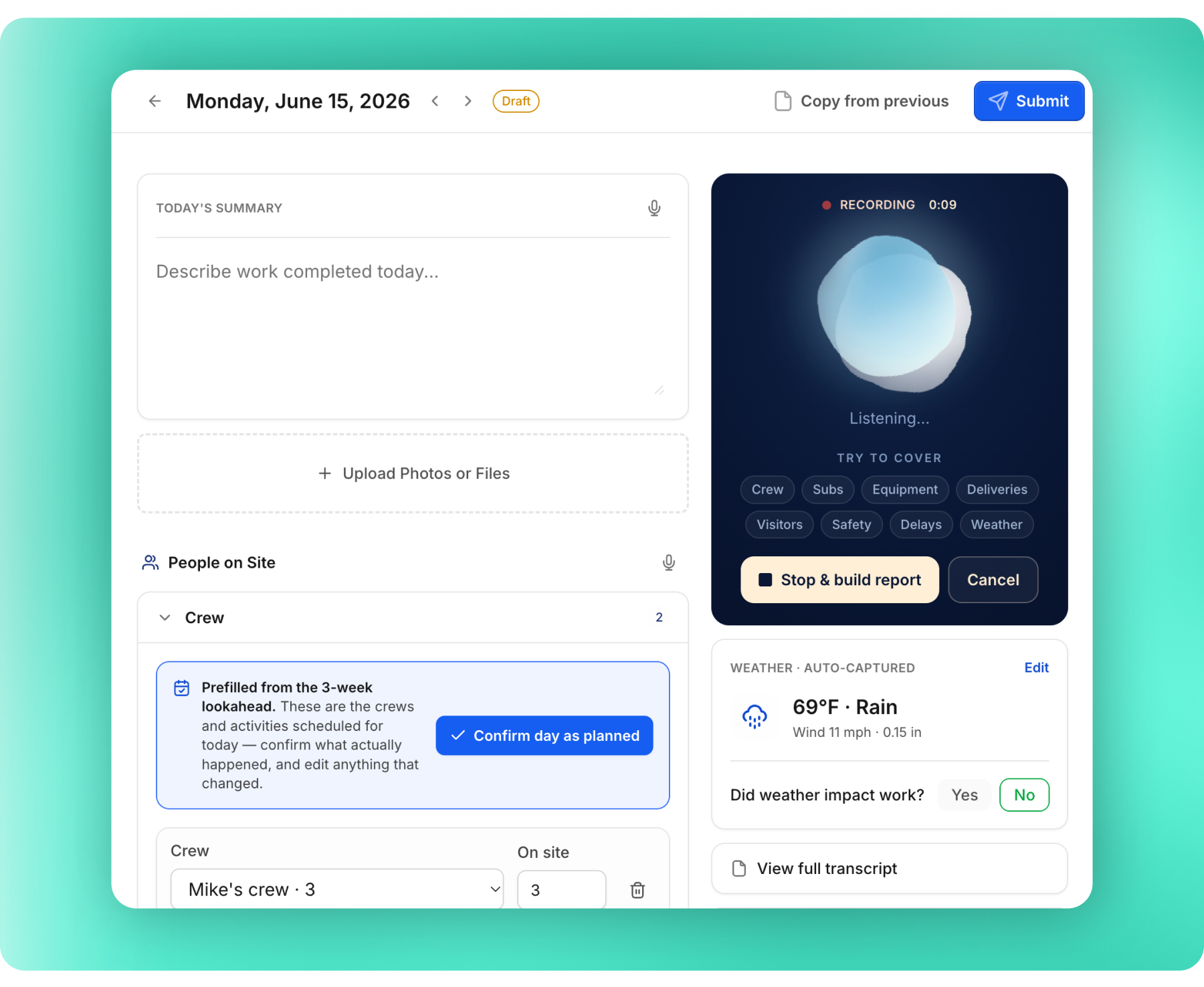
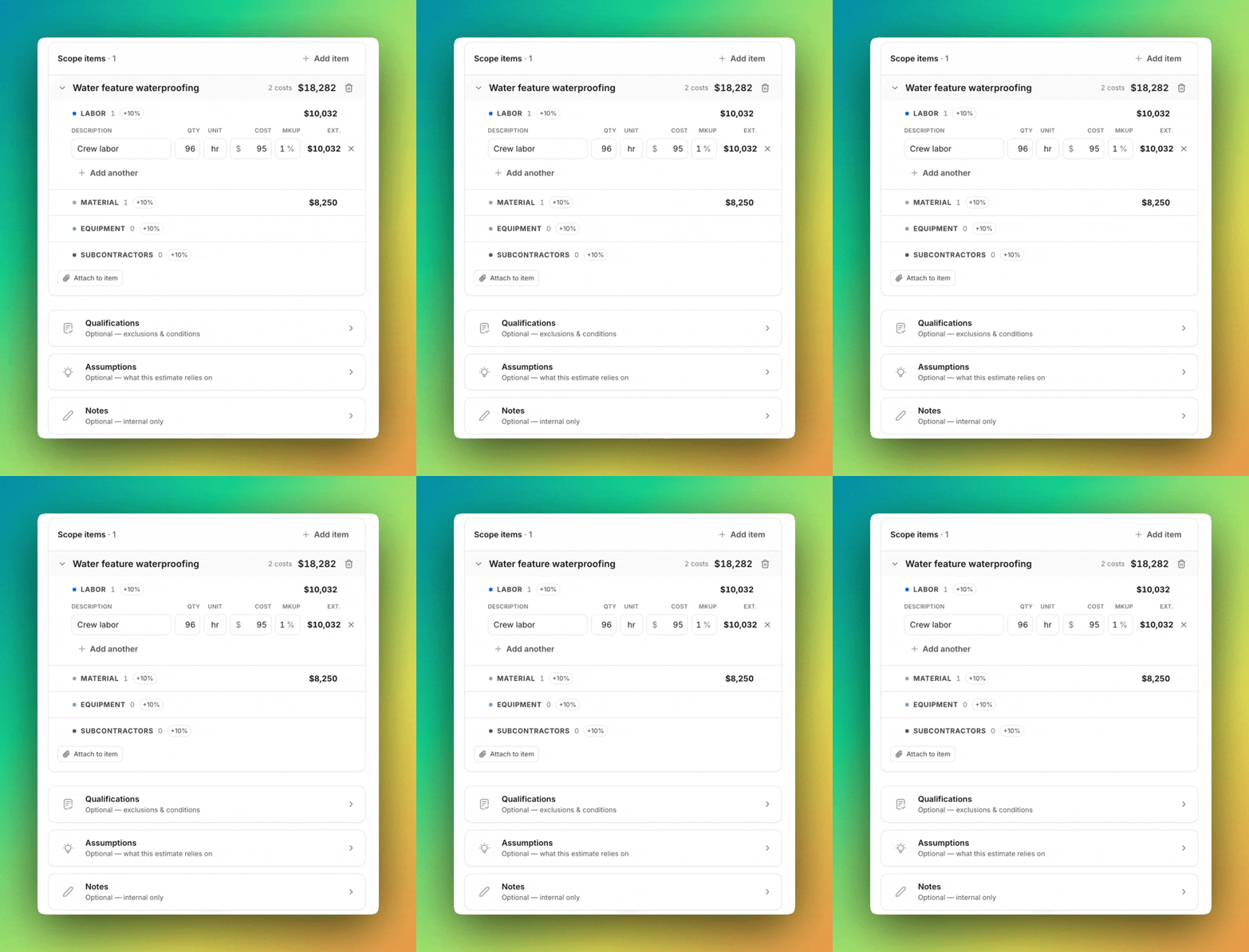
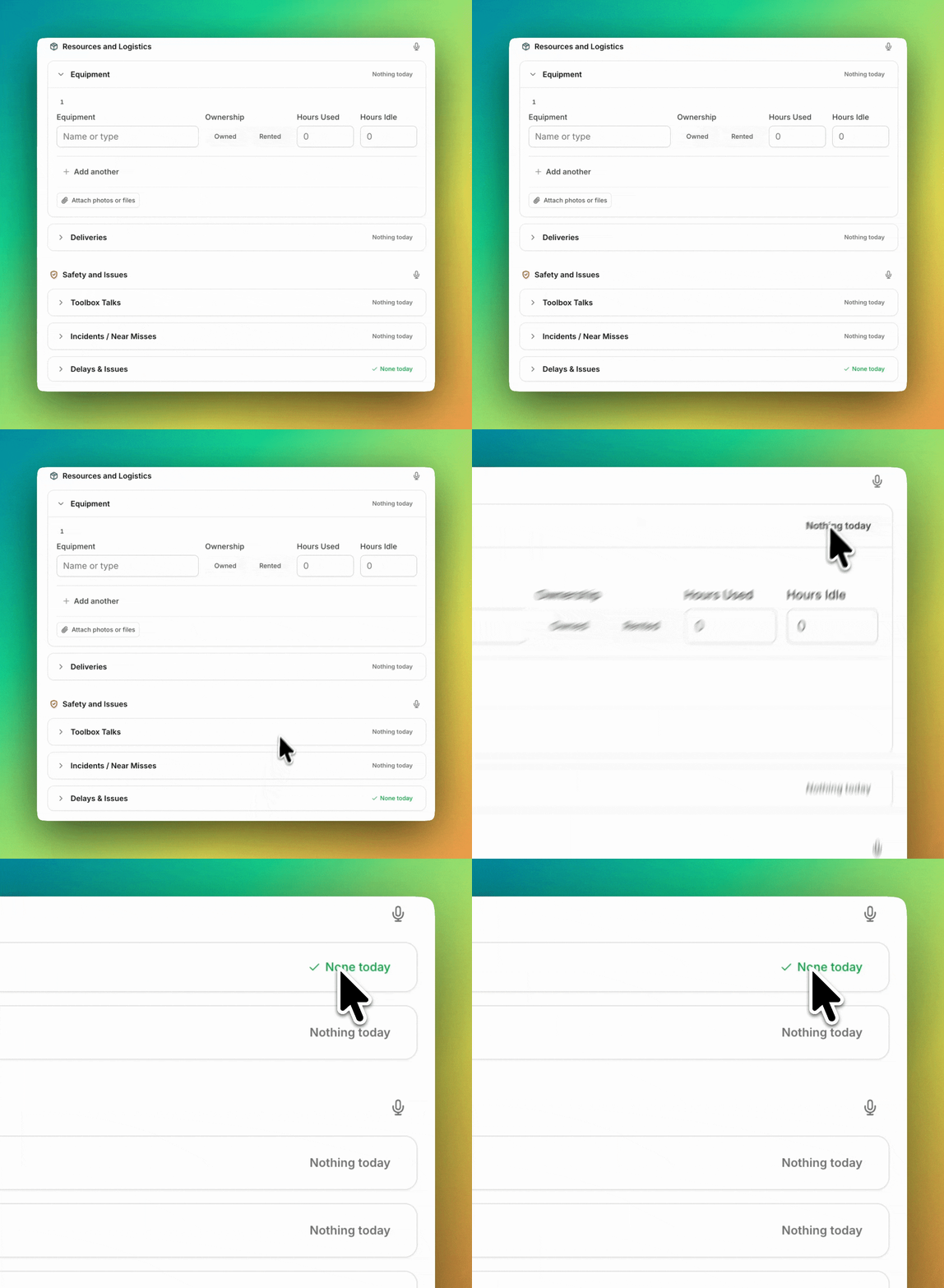
The real flow — hold to talk, watch Nova listen and tick off what you cover, then the structured report assembles itself for review.
Nobody becomes a superintendent because they love typing. The daily report is the most important document on a project and the least likely to get written — so I rebuilt the capture moment. Hold a button and talk; OpenAI Whisper hears it, Anthropic Claude shapes it into the report’s own sections, ready to review before anything is saved.
Submitted by the busiest people at the company, at the end of a long shift. As a result, reports either come in late or not at all, which means losing important information that could become a liability issue.
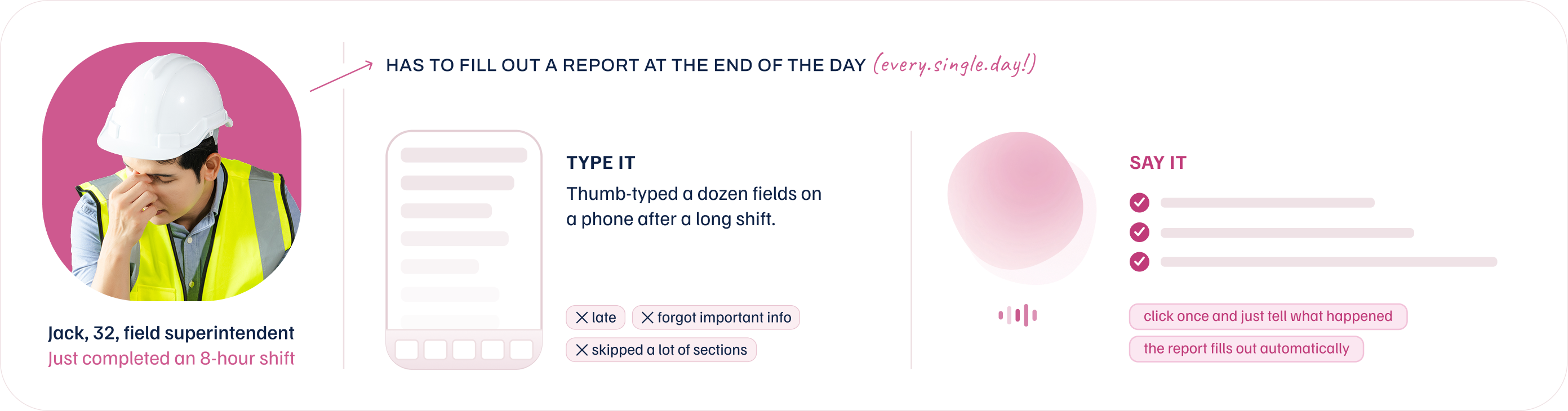
The goal is to make speaking the fastest way, so a user can just say what happened while they're walking to their car or driving home, click Submit, and forget about it. The report will organize itself into the correct fields.
Speech hides its own gaps. A live "try to cover" checklist ticks each section green as you mention it. Two speech engines, because one can’t do both jobs: an on-device recognizer gives instant captions while you talk, and Whisper produces the accurate record afterwards. Fast feedback and a trustworthy transcript are different problems.
Each section turns green the moment you mention it, so you can see what's still missing before you stop talking.
The mic stream encodes to Opus at a speech-optimized bitrate and buffers into short chunks, so upload starts before the sentence ends. Automatic gain keeps a quiet voice usable next to a running generator, a length cap stops runaway recordings.
Press stop, and the final chunk flushes and the stream closes.
On-deviceChunks stream to Whisper, tuned for how job sites actually sound: generators, traffic, wind, ten people talking (shouting) at once. It holds up across the heavy regional and non-native accents that break consumer dictation.
The output is deliberately raw, with every filler word, restart, and side comment kept, and timestamped, so any field downstream can be traced back to the words that produced it.
OpenAI WhisperClaude does the editorial work. Filler and false starts go, grammar gets fixed, rambling speech turns into an edited report summary without inventing a word that wasn't said.
Each statement routes to its place in that day's report (Summary, Safety, Deliveries, Crew, Equipment), constrained by the enabled-sections schema so it never fills a field the form doesn't have. Model tier scales with stakes: a light model for a one-line summary, a stronger one when the extraction is safety-critical.
Anthropic ClaudeThe result streams into the real form field by field. The user watches the report assemble instead of staring at a spinner. Every value stays editable and carries provenance back to its transcript line, so a name or a number can be checked against what was actually said.
Nothing touches the system of record until a person reads it and presses submit. The model proposes, the human commits.
Human-in-loopTwo dead ends from the build, each paired with what shipped instead — the wrong turns explain the decisions better than the final screens alone.
Talking was an accessory to typing.
The thousand-line form stayed the primary surface; dictation sat on top as a hero button.
Talking was an accessory to typing. The form still owned the interaction.
Voice became the input, the form became the output. That inversion is the product.
Nobody decides anything with a total.
Vanity counts: totals of reports filed, drafts pending. Tells users nothing about what's important.
Nobody decides anything with a total. A PM checking in before a field call only gets meaningless numbers.
Three decisions, not three counts: is coverage slipping, is the habit holding, what needs me now.
Voice input in a system of record only works if people trust what lands in the fields. Three rules keep it honest.
Whisper mishears money and codes. So transcription is proposed, never committed — it lands in an editable field for a human to confirm before it becomes part of the record.
Marking a section "none" is an audit-worthy claim. A verification step confirms the transcript holds a negation near a section keyword before stamping it — false affirmatives get dropped.
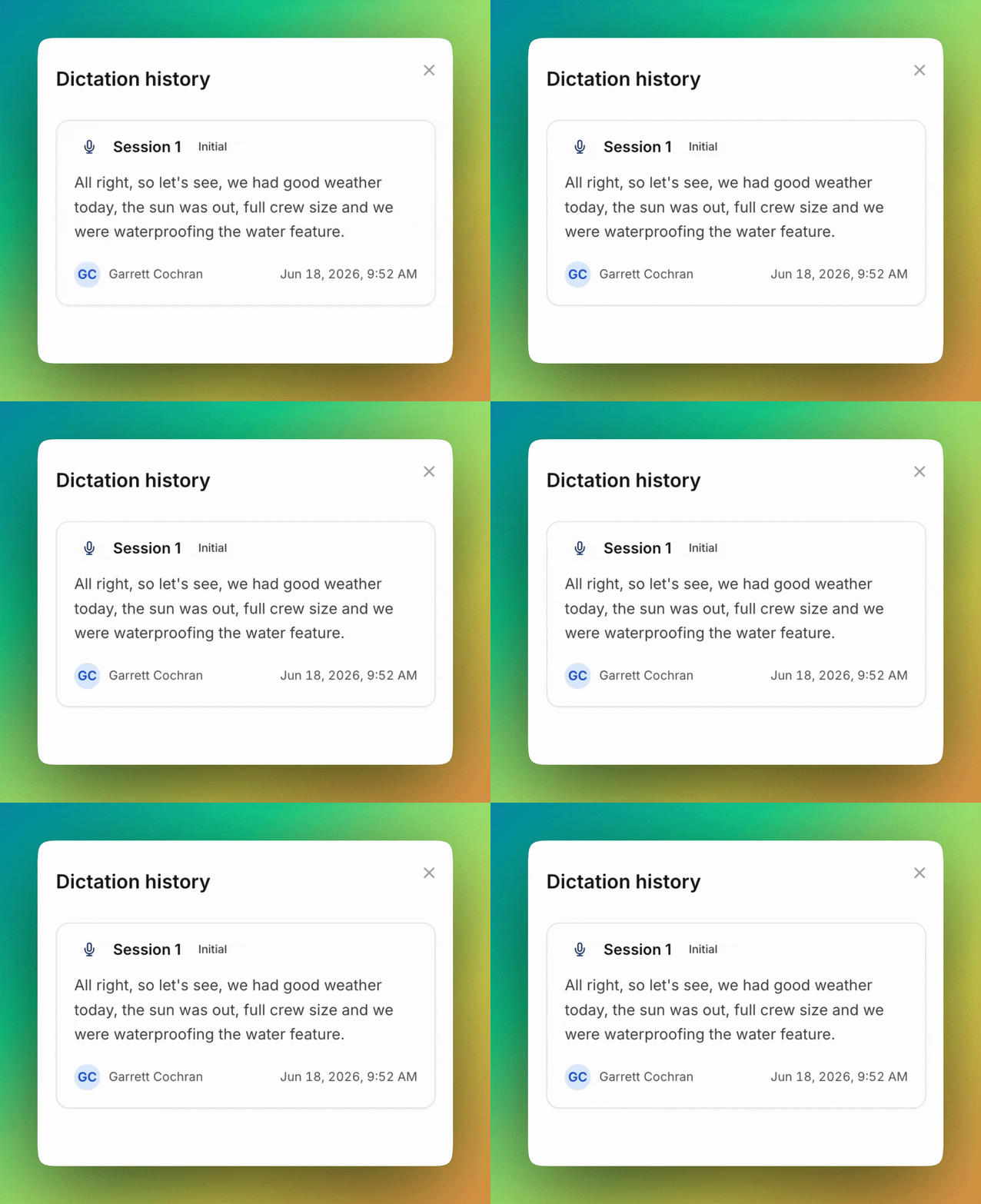
Each recording is its own timestamped session — speaker, time, verbatim transcript, audio — instead of one overwritten blob. In a document read in a dispute, provenance is the feature.